
 by TrueData
Paper trading and replay: practise the process
Use simulated execution and historical replay to test how you read context, timing and risk—not just whether a setup won.
FutPrint by TrueData · Published
Practise a decision before measuring a result
Historical replay and paper trading are useful because they let you repeat parts of a trading process without exposing capital to every experiment. Their value depends on the exercise you design. Clicking through a familiar session until the outcome looks obvious teaches something very different from recording a decision while the next bar remains hidden. Both use historical charts, but only the second preserves the uncertainty that matters.
Begin with a narrow skill. You might practise identifying whether price returned inside a prior range, comparing aggression with progress at a boundary, or following a predefined exit rule in a simulated position. “Become better at trading” is too broad to evaluate. A useful exercise states what information you will observe, what decision you will record and how you will assess consistency afterward.
This guide explains how to build such an exercise, distinguish the limitations of simulation and review a sample without rewriting its history. The numerical examples are hypothetical. They illustrate record keeping and measurement, not expected returns or suitable position sizes. The most valuable early result is often discovering that your rule is too vague to apply consistently.
Replay, paper trading and backtesting are different
Replay reveals historical information progressively. It helps you practise observation and timing without immediately seeing the full outcome. Paper trading simulates orders and positions under the platform's execution assumptions. Backtesting evaluates specified rules over historical data, often through an automated process. These activities can complement each other, but success in one does not establish success in the others.
A replay exercise might contain no orders at all. You could pause at ten events and classify the available evidence. A paper-trading exercise might use current market data rather than historical replay. An automated backtest might process thousands of observations without testing whether a person can follow the rules in real time. Identify which capability you are using before interpreting its results.
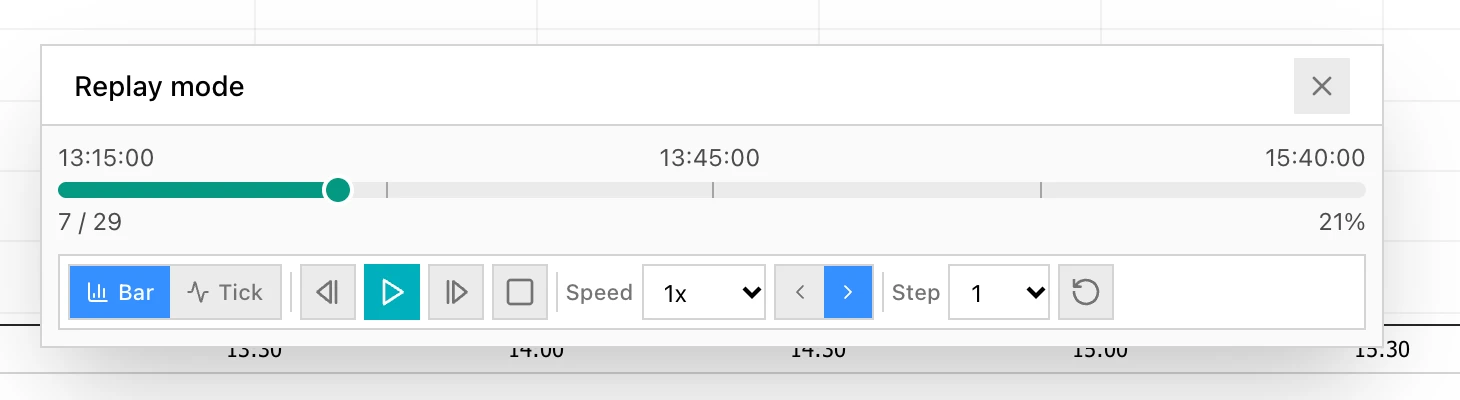
In FutPrint, replay supports revisiting chart history with playback and stepping controls. Available detail depends on the instrument and historical data. Paper-account tools and the journal support a separate practice workflow. Do not assume that every replay mode is connected to simulated order execution or that historical bars reconstruct every transaction inside them. Verify the supported combination before designing the exercise.
Write a protocol that another person could follow
A protocol should specify the instrument selection, session window, chart construction, observation rule and outcome measurement. If two people following the instructions would regularly choose different events, the definition needs work. Terms such as “strong buying” or “clear rejection” are useful shorthand only after you explain what observable behaviour qualifies and what does not.
For example, an observation study could examine the first return to a defined prior range after an opening outside it. Specify which range, which session hours and what constitutes a return. Decide whether you record the next five time bars, a fixed number of minutes or a defined price event. These choices produce different studies; none should be selected after seeing which produces the most attractive chart.
Also state the allowed actions. An observation-only exercise might permit “inside,” “outside” and “inconclusive.” A paper-trading exercise needs entry, invalidation, exit and cancellation rules. Include a no-action outcome. Without it, every chart becomes a forced trade and the exercise stops representing a process in which missing evidence can justify waiting.
Select sessions without choosing the answer
It is tempting to practise only on memorable trends, sharp reversals and screenshots shared by other traders. Those examples can teach vocabulary, but they are not a representative sample. Ordinary balanced sessions, ambiguous events, quiet periods and failed-looking patterns all belong in a broader study. Selecting the most dramatic outcomes first makes recognition seem easier than it is.
Use a selection rule that does not depend on the result. You might take consecutive eligible sessions or draw dates from a defined period before opening the charts. Record exclusions and their reasons, such as missing data. Do not quietly remove a session because it was confusing or because the rule performed poorly. Those cases may reveal the most important weaknesses.
Separate a development sample from a later evaluation sample. Use the first to clarify definitions and identify obvious implementation problems. Once the protocol is stable, apply it to dates you have not used for tuning. Repeatedly improving a rule on the same small set can fit the history while teaching very little about how it behaves elsewhere.
Keep the future hidden
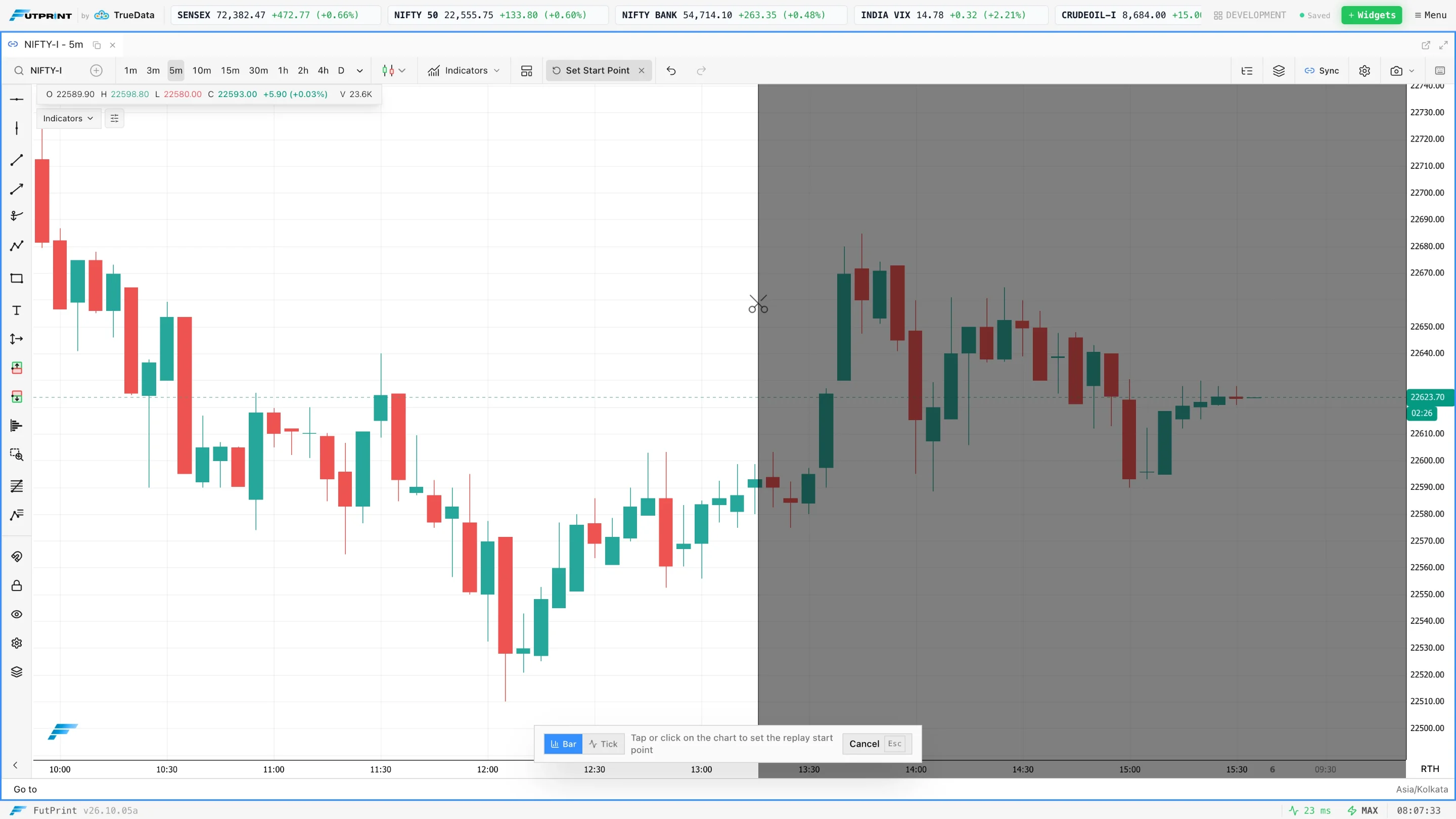
Start replay before the event rather than at the perfect entry candle. Allow enough preceding context to establish the references required by the protocol. Hide or avoid other panels that reveal later prices, completed session profiles or end-of-day totals. A chart with future information elsewhere on the screen can undermine the exercise even if the main panel is playing correctly.
Pause at predefined decision points and write the observation before advancing. Record what you know, what remains uncertain and what would change the current interpretation. If you rewind after a mistake, label the repeat as practice rather than counting it as a fresh independent attempt. Familiarity with the outcome changes the task, even when you try to ignore it.
Choose playback speed according to the skill. Faster playback can help classify broad session structure. Detailed order-flow study requires enough time to inspect the relevant information, and bar-level history cannot substitute for unavailable transaction history. Slowing an animation does not create missing granularity. Match the claim you make to the data the replay actually reveals.
Make simulated execution assumptions explicit
A simulated fill is a model of execution. Real orders interact with available liquidity, queue position, spread, latency and other participants. A chart touching a limit price does not establish that your order would have filled in full. Likewise, a stop level does not guarantee an exact execution price during a gap or a fast move.
Write down how the simulator handles these situations where that information is available. When it is not available, mark the assumption as unknown and avoid presenting the resulting profit figure as precise. For manual exercises, define a consistent conservative convention before starting. Do not grant yourself favourable fills on winning examples while applying stricter assumptions only to losing ones.
Include applicable costs in any performance calculation. Brokerage, exchange-related charges, taxes and other costs vary by instrument and account arrangement, so use the relevant verified schedule for your own study. Record gross and net results separately. Small apparent advantages can disappear when repeated transactions, spread and execution differences are included.
Record risk in comparable units
A risk unit, often called R, can make outcomes easier to compare when the planned distance to invalidation differs. Define one R as the planned monetary risk for the particular simulated trade. If that planned risk is 500 hypothetical currency units, a net loss of 250 is minus 0.5R and a net gain of 750 is plus 1.5R.
The definition must remain consistent. If you use a price stop to calculate planned risk, include the quantity and contract multiplier where relevant. If execution occurs beyond the assumed stop, the realised loss can exceed one R. Calling something a one-R trade does not cap its outcome. Preserve both the original plan and the actual simulated result rather than redefining risk afterward.
For an observation study without trades, use a different measurement. You might record maximum movement above and below a reference over a fixed window. Do not call that movement achievable profit unless an entry and exit procedure could have captured it under stated execution assumptions. Descriptive movement and executable return answer different questions.
A worked review example
Imagine five simulated outcomes, already expressed after the costs used in the exercise: plus 1.5R, minus 1R, plus 0.5R, minus 1R and plus 2R. The total is plus 2R, and the arithmetic mean is plus 0.4R per attempt. Three of five outcomes are positive. These calculations describe this tiny sample; they do not establish a stable expectation for future trades.
Now inspect the process record. Suppose the plus 2R result came from an entry outside the written rule, while the two losses followed it exactly. The aggregate number conceals a process violation. Do not retroactively redefine the rule to include the attractive exception. Report rule-compliant and non-compliant attempts separately and study the exception as a new hypothesis if it deserves further attention.
Also consider sequence. The same total can involve different drawdowns depending on the order of outcomes. A short favourable sample may omit difficult market conditions entirely. Keep the dates, sequence, skipped events and unresolved cases alongside summary statistics. A compact performance number should lead back to the underlying record, not replace it.
Build a journal that preserves the evidence
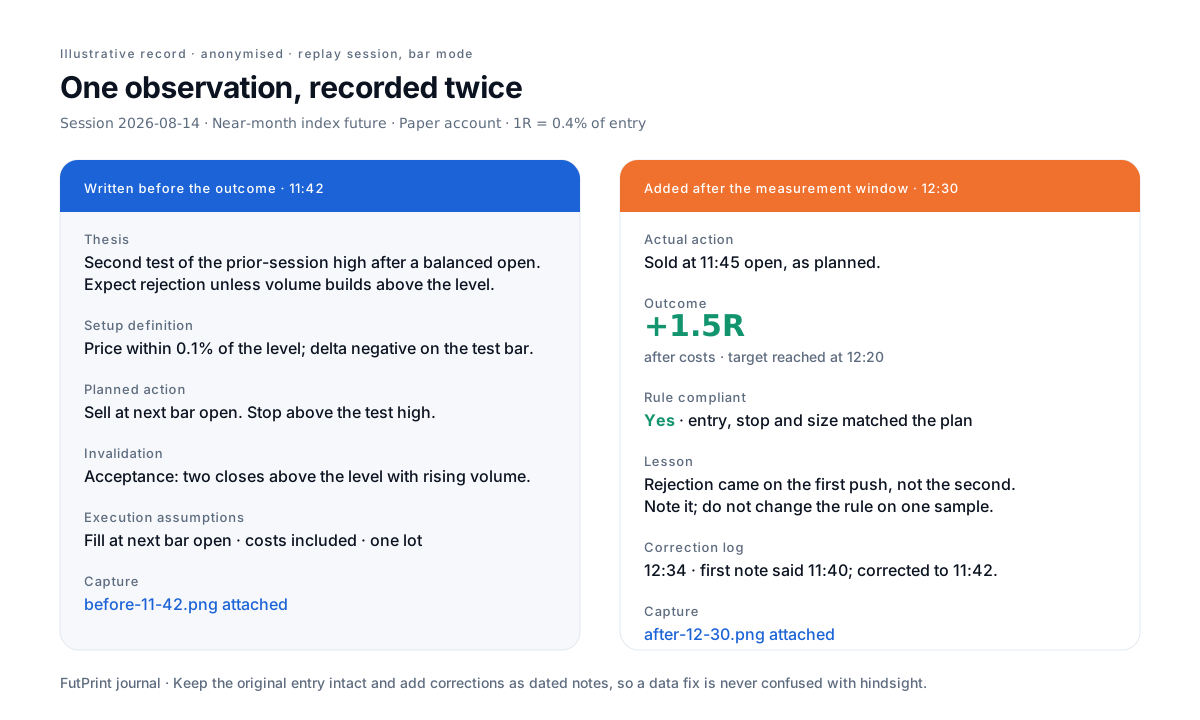
Use a small set of fields consistently: date, instrument, data mode, setup definition, observation time, planned action, invalidation, actual action and review note. Attach a capture made before the outcome and another after the measurement window. For simulated trades, include quantity, fill assumptions, costs and the result in both monetary and comparable units.
Separate what the platform records automatically from what you must add. FutPrint's journal can support review of recorded paper activity and manual notes, but an order record does not explain why you acted. Add the reasoning while it is fresh. A later narrative that sounds coherent can differ substantially from what you actually believed at the decision point.
Keep the original entry immutable in spirit, even if the interface permits editing. Add corrections as dated notes rather than silently replacing the first explanation. This allows you to distinguish a data correction from hindsight. A useful journal includes uncertainty, missed observations and mistakes; it is a working record rather than a collection of successful demonstrations.
Score the process separately from the outcome
A simple process score can ask whether the event met the definition, whether the decision was recorded before advancing, whether the action matched the rule and whether the review was completed. Keep the questions binary or clearly described. An elaborate score with subjective categories can become another way to reward examples you already like.
Review four combinations: good process with a favourable outcome, good process with an unfavourable outcome, poor process with a favourable outcome and poor process with an unfavourable outcome. The third category deserves particular attention because it can reinforce an unreliable habit. The second prevents you from discarding a consistent procedure solely because one uncertain event did not work out.
Process consistency alone does not prove a method has an advantage. It establishes that you are evaluating something repeatable. Once the procedure can be applied consistently, broader sampling and realistic assumptions become more meaningful. Without consistency, changes in performance may simply reflect changes in what you are doing.
Common ways practice becomes misleading
One problem is changing settings after every disappointing example. A different footprint row size, interval or threshold may make the past easier to explain, but repeated tuning destroys comparability. Record proposed changes and evaluate them in a separate version. Another problem is counting multiple replays of the same event as independent evidence. Repetition develops familiarity, not additional market observations.
Missing trades and cancelled ideas also matter. If the exercise only records completed positions, it may hide hesitation, unavailable fills or a selection rule that produces very few usable events. Include eligible events where no trade occurred and explain why. This gives the review a denominator and prevents the results from becoming a curated subset.
Finally, simulation does not reproduce every emotional or operational feature of live participation. Knowing that losses are simulated can change behaviour. Connection interruptions, order handling and real execution introduce additional uncertainty. Progress in practice should be described as progress in the tested process, not a promise that the same results will transfer unchanged.
A four-session practice plan
Use the first session to write and test the protocol without measuring performance. Identify ambiguous terms and verify the replay controls and data coverage. Use the second to collect observations with the future hidden. Keep the settings fixed and record every eligible event, including inconclusive cases. The aim is a clean record rather than a high score.
Use the third session for review. Check whether another reader could reconstruct each decision from the saved evidence. Separate rule failures, data problems and ordinary unfavourable outcomes. Choose at most one substantial revision. In the fourth session, apply the revised protocol to a fresh sample and compare consistency before comparing results.
Questions to answer before the next exercise
- What exact skill or rule am I testing?
- How were the sessions selected, and what information is hidden?
- What historical detail and simulated execution assumptions are available?
- What counts as an eligible event, including a no-action outcome?
- How will costs, rule violations and missing data be recorded?
- Which sample will remain untouched until the protocol is stable?
Practice becomes useful when the record is honest enough to expose weaknesses. A replay that disproves an attractive idea can be more valuable than one that produces an impressive simulated result. The objective is to leave the exercise with a clearer definition, a better measurement and a decision process that can be examined without relying on hindsight.